
BACK, JOINT & SPINE COACHING
Injured, not broken.
Safe strength training for your back, neck and joints. I help you train around an injury or joint issue, prevent them, and get back to your performance, working alongside your physio or doctor.
Who it’s for
Back and neck pain
Low back pain, neck pain, herniated or bulging discs: learn to move and train again with confidence.
Shoulders, knees and hips
Recurring pain or joints that hold you back in the gym, on your runs or in everyday life.
After physio
You’ve finished rehab and want to get back to training and to your performance, without starting from scratch.
My story
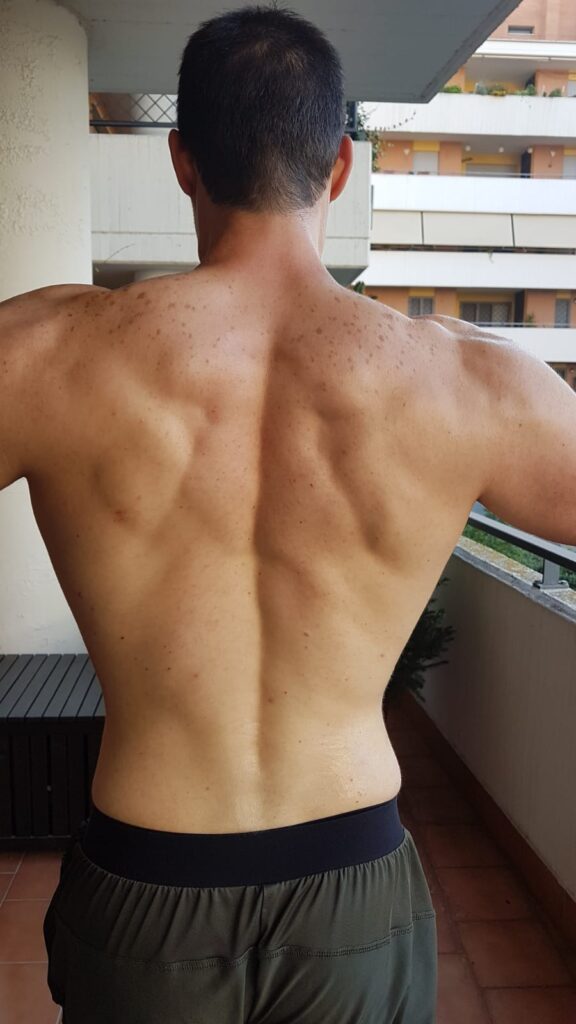
I had a lumbar disc herniation. I know the pain, the fear of moving and the feeling that your body can no longer be trusted.
I got through it with patience and well-built training, and today I do every kind of training again. That’s where this path comes from: I know what you’re going through, and I know you can start again.
What the science says
No miracles and no scaremongering: just what the research tells us today.
Movement helps
International guidelines on low back pain (NICE 2016, The Lancet series 2018) recommend staying active and using exercise as a first-line treatment. Prolonged bed rest, on the other hand, is not recommended.
Exercise reduces pain
A 2021 Cochrane review (Hayden et al.), pooling hundreds of studies, concludes that exercise probably reduces pain in chronic low back pain compared with no treatment.
A scan is not a sentence
In a review of more than 3,000 people without pain (Brinjikji et al., 2015), signs of disc degeneration were found in 37% of people in their twenties and 96% of people in their eighties. What you see on an MRI doesn’t always explain the pain.
Well-dosed load is part of the cure
Muscles, tendons and bones adapt to the load they receive. That’s why the core of the path is progressive strength training: we start where you are and only increase when your body responds well.
Joints and osteoarthritis
International guidelines on knee and hip osteoarthritis (OARSI, 2019) recommend exercise as a core treatment, alongside other therapies.
Pain is an alarm, not a verdict
Pain is a protective system and doesn’t always match damage. Understanding this reduces the fear of moving, and less fear means more movement and better recovery.
How we work
1. Free assessment
A short introductory call to understand your story, your limits and your goals.
2. 1:1 consultation
About an hour focused on your problem, so you leave with a clear strategy to tackle it.
3. The programme, if you choose it
A tailored, progressive strength programme, coordinated with your doctor or physio.
4. Return to performance
From “I can do it without fear” to “I can do it better than before”: we get you back to the training and sports you love.
Start here
Everything starts with a conversation. No pressure and no hard selling: you decide if, when and how to go further.
FREE
Free assessment
A short 20-30 minute introductory call, with no commitment, to understand your situation and see whether I can help.
If you have medical reports, email them at least the day before or show them during the call.
€150
1:1 consultation
About one hour by video call, focused on the problem or situation you bring me. My goal is to give you a concrete strategy to tackle it.
You pay directly here on the site and immediately receive an email with the link to choose your day and time.
4, 8 OR 12 MONTHS
Coaching programme
A complete programme: tailored training plan, tips for anti-inflammatory eating, chat support and video calls when you need them, and coordination with your doctor or physio (or help finding one).
It always starts after a consultation, whose cost is deducted from the programme. I won’t try to sell you anything during the consultation: if you want to keep working together, you’ll be the one to ask, and only then will we talk about duration and cost.
When to see a doctor first
Contact your doctor straight away, before starting any training, if the pain follows a significant trauma, or if you notice worsening weakness, tingling or numbness, problems controlling your bladder or bowels, fever, or severe, constant pain even at rest and at night.
Frequently asked questions
Can I train with a herniated or bulging disc?
In most cases yes, with your doctor’s go-ahead and a gradual programme. The goal isn’t to avoid movement, but to get it back safely.
Will you diagnose me?
No. Diagnosis is for your doctor or physio. I build your training on their guidance and work alongside them.
Can you promise I’ll be pain-free?
No one can honestly promise that. What I can do is help you move better, get stronger and understand your body, which is the path research shows to be the most effective.
Do I need a gym?
No. We can also work at home with minimal equipment, adapting the exercises to what you have.
Which languages do you work in?
English and Italian, online, wherever you are.
How much does the coaching programme cost?
It depends on the length and on what you need. We only talk about it during the consultation, and only if you want to: there are no prices here because every programme is built around the person.
The content on this page is for information and education only and does not replace advice from your doctor or physiotherapist.